Combatting Information Manipulation Tactics in Ethiopia and South Sudan


Overview
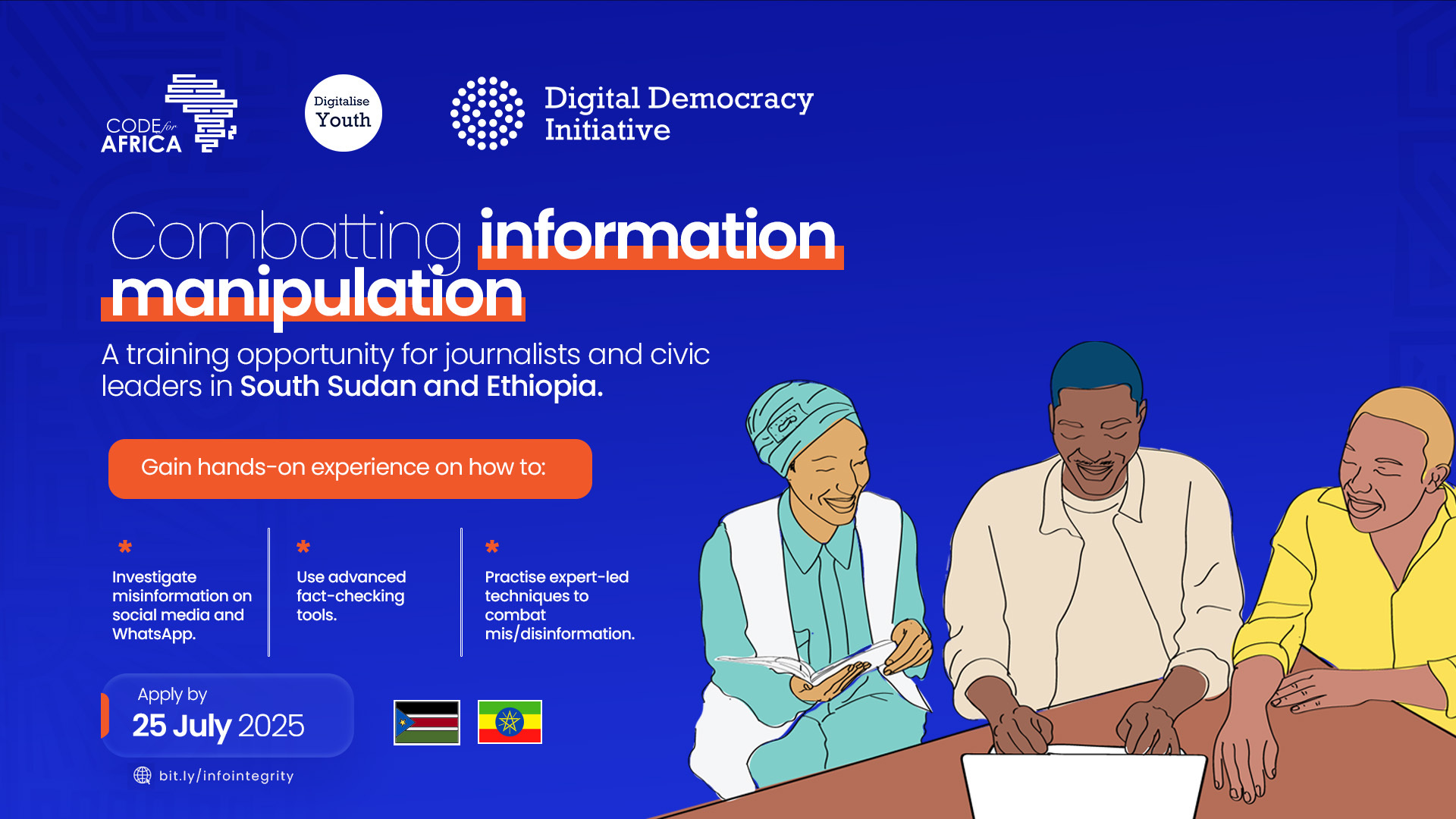
As part of the Digitalise Youth project, part of the Digital Democracy Initiative, Code for Africa (CfA), is offering free online Info-integrity Training. This is a chance for you as a media professional, journalist, fact-checker, and digital investigator to strengthen your fact-checking skills and connect with others working to verify counter disinformation. This training will help participants detect and verify misleading content, investigate harmful narratives, and respond to disinformation with evidence-based reporting. The course includes instructor-led webinars exploring fact-checking techniques, open-source investigation tools, and methods for identifying coordinated campaigns.The training will run from 29 July to 03 September 2025. Applications close on 25 July 2025. For details on eligibility and application requirements, please refer to the sections below.
Apply now to strengthen your fact-checking skills.
About the Training
Learning Objectives
✅ Master fundamental fact-checking techniques for various content formats, including photos, videos, audio, and websites.✅ Develop proficiency in both prebunking and debunking strategies for identifying and countering misinformation.
✅ Apply ethical guidelines for plagiarism and verify factual integrity in the digital age.
✅ Understand and navigate the intersection of AI and fact-checking to improve editorial efficiency and accuracy.
✅ Safeguard digital security while performing fact-checking in high-risk environments.
✅ Explore methods for investigating misinformation on social media, including dark social channels like WhatsApp.
Cost
This training is offered at no cost to selected participants, ensuring accessibility for individuals and organisations committed to advancing their skills in fact-checking and information integrity. The training materials for those admitted into the training programme will be made available on our MOOC platform for future reference and self-guided learning.Schedule and Duration
The course will run online via Zoom from 29 July to 03 September 2025, with weekly sessions of 90 minutes each. A total of 15 sessions spread across six weeks, three times a week will be conducted. Satisfactory participation throughout the training will enable participants to receive a certificate of completion endorsed by all training partners. This structured schedule ensures that trainees gain a deep, progressive understanding of fact-checking over the course of the program.Curriculum Overview
✅Fact-Checking Fundamentals✅Prebunking and Debunking Techniques
✅Verifying Photos, Videos, and Audio Content
✅Ethical Fact-Checking and Plagiarism Guidelines
✅Investigating Misinformation and Information Operations
Delivery
The course will be delivered entirely online, ensuring accessibility to participants in Ethiopia and South Sudan. The program will feature instructor-led sessions with resources uploaded to our MOOC platform, allowing participants to engage with the material at their own pace while benefiting from real-time interaction and mentorship.This blended approach ensures a structured yet flexible learning experience, combining theoretical foundations with hands-on practical application. Live sessions will be delivered by cyber security experts from Code for Africa (CfA). The course will be delivered in English only.
Eligibility Criteria
Applicants must meet the following criteria:- Target Countries – Eligibility is open to individuals residing or engaged in professional work in Ethiopia and South Sudan
- Current Employment – Priority will be given to individuals currently working as journalists, fact-checkers, and researchers or in roles within newsrooms and civil society organisations (CSOs) that support local information integrity watchdogs and human rights defenders.
- Language – Applicants must be fluent in English.
- Availability – Applicants must be available to participate in virtual training.
- Partisanship – Applicants must be non-partisan and have no affiliations with government agencies, paramilitary organisations, political parties, state-affiliated media, or any other entities that could create the perception of partisanship during elections.
- Accessibility – Applicants must have access to a reliable laptop or desktop computer with stable internet connectivity to participate in program activities, online courses, and mentoring.
- Commitment – Applicants must commit to sharing their newly acquired skills and knowledge within their organisations, with their followers, and across the wider journalism/research community by showcasing their projects and techniques to their peers.
Deadline
- All applications must be submitted by midnight EAT on 25 July 2025.
- Late submissions will not be considered.
- Applicants are encouraged to apply early to ensure they have ample time to complete the process and secure a spot in the programme.
How to Apply
☑️All applications must be completed through the provided online form☑️ Successful applicants will be notified by 28 July 2025.
☑️No interviews or assessments will be conducted as part of the selection process.
Inquiries
Applicants are encouraged to consult the growing list of frequently asked questions (FAQs) below. If your question has not been answered, please send an email to rose@codeforafrica.org with the subject “Fact-Checking Training for Ethiopia and South Sudan”.Frequently Asked Questions
- What software or tools do I need for the training?
- Will the sessions be recorded?
- Will I have assignments or coursework outside of the sessions?
- Can I take the course at my own pace?
- Will I receive technical support during the training?
- How will this training help my career?
- What makes this training unique?
The Speaker
The Organisation
Code for Africa
Code for Africa (CfA) is the continent’s largest network of indigenous African civic technology and investigative data journalism laboratories, with over 100 staff in 21 countries, who build digital democracy solutions that are intended to give citizens unfettered access to actionable information that empowers them to make informed decisions and that strengthen civic engagement for improved public governance and accountability.
The Organisation
Digitalise Youth Consortium
The Digitalise Youth Consortium is a partnership of six organisations—European Partnership for Democracy (EPD), AfricTivistes, Code for Africa (CfA), CFI Media Development, World Scout Bureau Africa Regional Office, Kofi Annan Foundation (KAF)—working together on the Digitalise Youth Project, powered by the Digital Democracy Initiative.